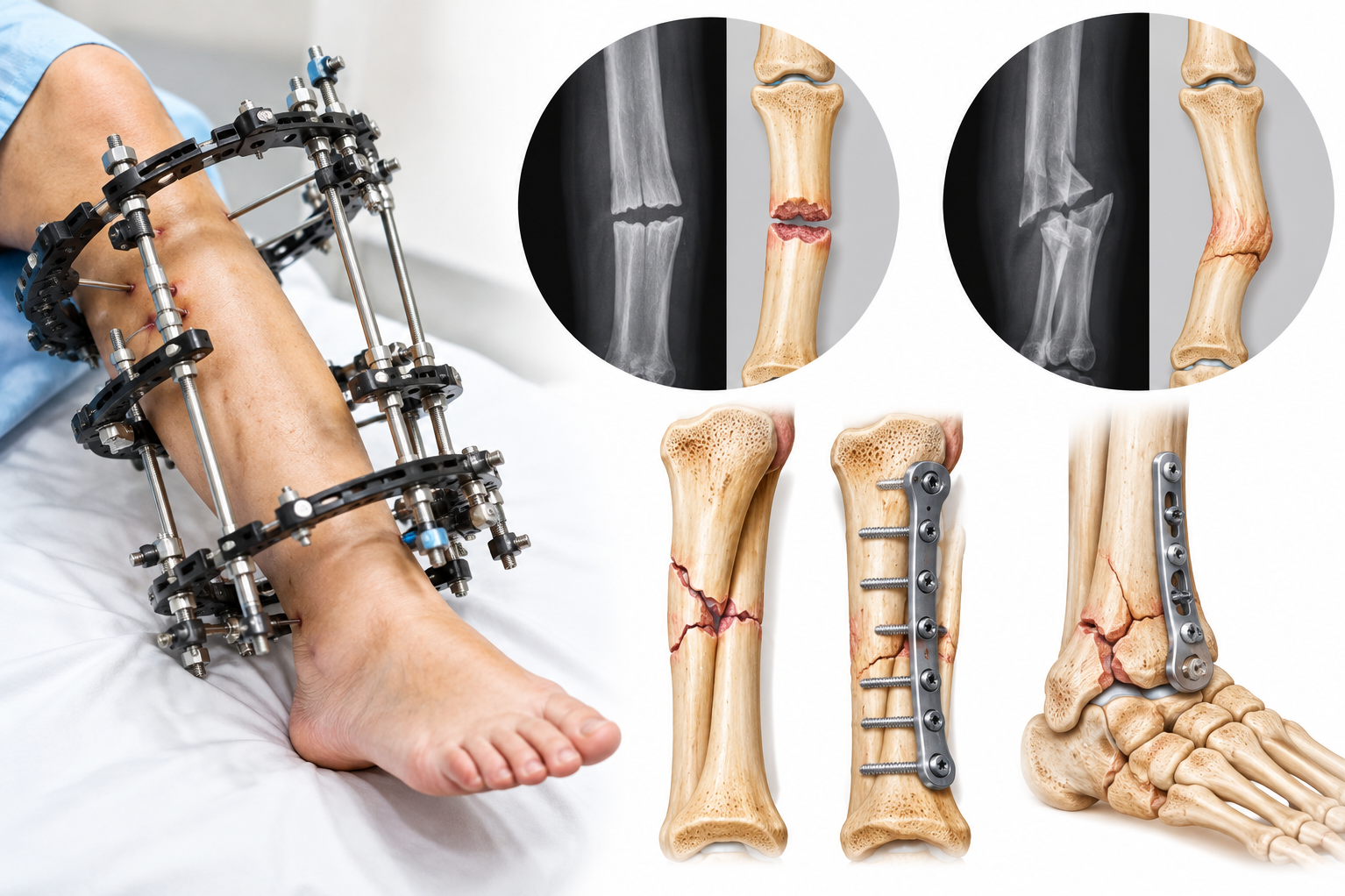
Most fractures progress toward healing when they have adequate stability, blood supply, and biological support. Sometimes healing does not occur as expected, or the bone heals in an unsatisfactory position.
Nonunion describes a fracture that has failed to show expected healing progression. Malunion means that the fracture has healed with unacceptable angulation, rotation, shortening, or displacement. Both conditions require careful investigation before corrective treatment is selected.
For patients seeking nonunion and malunion fracture treatment in Moshi, the quality of assessment is as important as the eventual procedure.
Look for a Cause-Based Evaluation
Nonunion is not a single disease. Contributing factors may include:
- Inadequate fracture stability
- A gap between bone ends
- Poor blood supply
- Severe initial soft-tissue injury
- Infection
- Bone loss
- Smoking
- Poorly controlled diabetes
- Nutritional deficiency
- Early or excessive loading
- Certain medicines or health conditions
A care team should investigate why healing failed rather than simply repeat the original treatment.
Confirm Whether Infection Is Present
Infection can be obvious, with discharge, redness, fever, or an open wound. It can also be subtle. Blood tests, imaging, tissue samples, or cultures may be needed.
This distinction matters because an infected nonunion may require removal of infected tissue, microbiological testing, staged fixation, antibiotics, and reconstruction. Treating it like a routine uninfected nonunion can lead to repeated failure.
Expect Detailed Imaging and Alignment Assessment
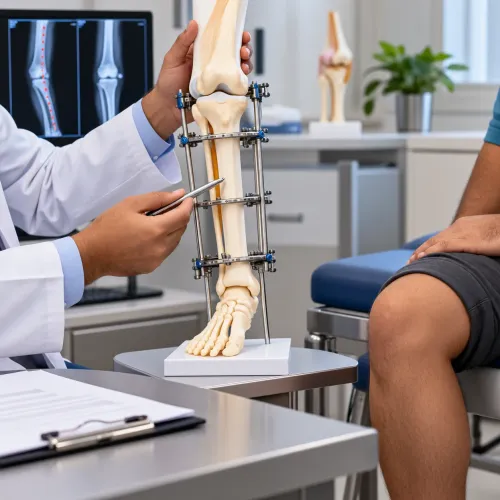
X-rays help evaluate fracture position, implant condition, and healing progress. CT may be useful when union is uncertain or the deformity is complex.
For malunion, standing alignment images or rotational studies may be needed. The team should assess how the deformity affects nearby joints, walking, limb length, and daily function.
Ask About Mechanical and Biological Treatment
Successful nonunion treatment often requires attention to two areas:
- Mechanical stability, provided through suitable fixation
- Biological healing, supported by viable bone, blood supply, and grafting when required
Treatment may involve revision fixation, bone grafting, correction of deformity, infection control, bone transport, or other reconstructive strategies. The choice depends on the bone involved, size of the defect, soft-tissue condition, previous operations, and patient health.
Malunion correction may require a planned bone cut, realignment, and stable fixation. Not every radiographic deformity requires surgery; the decision depends on pain, functional limitation, progression, and expected benefit.
Evaluate the Follow-Up Plan
Complex fracture reconstruction rarely ends at discharge. Before choosing a provider, ask how the team will monitor:
- Wound healing
- Infection markers where relevant
- Bone formation on imaging
- Implant stability
- Limb alignment
- Weight-bearing progression
- Joint movement
- Muscle strength
- Return to work and daily activity
Patients should also receive instructions about nutrition, smoking cessation, diabetes control, and symptoms requiring early review.
Anand Orthopaedic Hospital in Moshi assesses patients with delayed fracture healing, nonunion, malunion, and post-traumatic deformity from across Pimpri-Chinchwad and Pune. The treatment pathway may involve diagnostic testing, infection assessment, revision surgery, reconstruction, and supervised rehabilitation.
A suitable care team should explain the cause of the problem, whether infection is suspected, what reconstruction is proposed, and how progress will be measured. Nonunion and malunion treatment can be demanding, but a systematic plan gives patients clearer expectations and reduces decisions based solely on pain or a single X-ray.
Keywords