Returning to sport is not the same as becoming pain-free. An athlete may feel comfortable during ordinary walking yet still lack the strength, balance, mobility, or confidence required for running, jumping, turning, or contact.
Before resuming training, an assessment by a sports injury orthopedic doctor in PCMC can help determine whether the injured structure has healed sufficiently and whether physical function has been restored.
Confirm the Diagnosis
Sports injury can describe damage to muscles, tendons, ligaments, cartilage, joints, or bones. Similar symptoms may have different causes.
For example, knee pain after twisting could involve a ligament, meniscus, kneecap, cartilage surface, or bone. Shoulder pain in a throwing athlete could arise from the rotator cuff, labrum, instability, or movement mechanics.
Clinical examination guides the need for X-rays, ultrasound, MRI, or other investigations.
Check Swelling and Pain Response
The absence of pain at rest is only an early milestone. Consider whether the joint swells after activity, aches the following morning, or becomes painful at a specific training intensity.
Persistent or recurring swelling may indicate that the injured area is not tolerating the current load. Increasing activity despite this response can prolong recovery.
Restore Range of Motion
Restricted movement can change technique and transfer stress to other areas. An athlete returning after an ankle injury, for instance, may compensate through the knee, hip, or opposite leg.
Movement should be compared with the uninjured side where appropriate. Some sports require more mobility than ordinary daily activity, so general function alone may not be enough.
Rebuild Strength and Control
A return-to-sport programme may evaluate:
- Muscle strength
- Single-leg balance
- Landing control
- Direction changes
- Endurance
- Joint stability
- Sport-specific technique
- Reaction under fatigue
- Psychological confidence
Testing should reflect the athlete’s actual demands. A runner, football player, badminton player, and strength athlete do not need identical clearance criteria.
Progress Through Training Stages
A graded progression may move from basic rehabilitation to individual conditioning, non-contact drills, controlled team practice, full training, and finally competition.
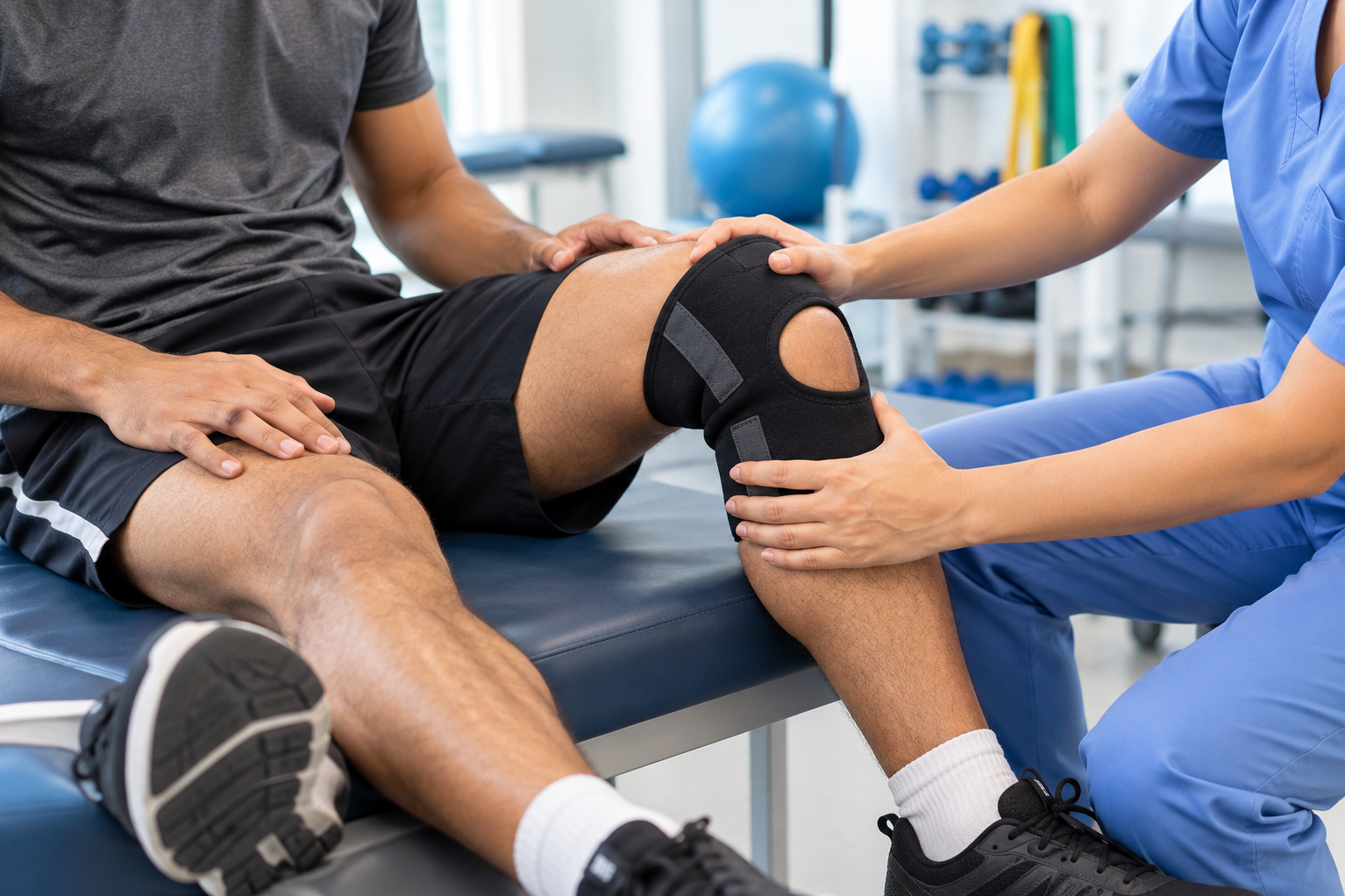
Skipping stages because an important match is approaching can expose incompletely recovered tissue to sudden load. Protective taping or bracing may support selected injuries, but it cannot replace adequate healing and conditioning.
Identify Why the Injury Happened
Some injuries result from direct contact and cannot be fully prevented. Others may be associated with rapid training increases, inadequate recovery, poor technique, unsuitable equipment, limited mobility, or muscle imbalance.
Reviewing training volume and movement patterns can reduce repeated problems. This is particularly important for recurring ankle sprains, hamstring injuries, shoulder pain, and overuse conditions.
Know When Specialist Review Is Needed
Evaluation is advisable when there is joint instability, locking, recurrent swelling, inability to bear weight, visible deformity, persistent pain, or weakness. A sudden pop followed by swelling or loss of function also warrants assessment.
Anand Orthopaedic Hospital supports sports injury patients from Moshi, PCMC, and nearby Pune communities with diagnosis, non-operative care, surgical evaluation where indicated, and rehabilitation planning.
A safe return is based on healing and measurable function rather than a fixed number of days. Before returning to unrestricted sport, the athlete should understand the diagnosis, complete the recommended progression, and demonstrate that the injured area can tolerate relevant movements without instability or a significant adverse response.
Keywords